

The best beaches near Kardamena, and how to actually get to each one
Our own beach is 500 m from the door: long fine sand, south-facing, sheltered from the wind that spoils afternoons on the other side of the island. The one everybody asks about is Paradise Beach in Kefalos Bay, about 20 km west, where volcanic gas bubbles up through the seabed a few metres offshore. Sunbeds are around €10 for two loungers and an umbrella almost everywhere. Here is every beach worth the drive, and how to reach each one.
On this page
- Our own beach, and the empty stretch west of it
- Every beach, compared
- Paradise Beach, and why the water bubbles
- Camel Beach, next door and quieter
- Agios Stefanos and the islet of Kastri
- Kefalos and Lagada
- The wild ones: Cavo Paradiso and Agios Theologos
- The north coast, and the wind nobody warns you about
- Sunbeds, umbrellas and what they should cost
- The 2026 beach rules and the MyCoast app
- Getting to all of this
Our own beach, and the empty stretch west of it
Kardamena beach is a long town beach of fine sand with everything on it: beds, bars, showers, food. It is 500 m from us, and the waterfront is flat and palm-lined, which matters with a pram or with knees that are not what they were.
The part that gets underrated is the direction it faces. Kardamena looks south, and we come back to what that is worth further down.
If the town stretch feels busy in August, keep walking west. Past Cape Helona, between the Robinson Club and Blue Lagoon Village, the sand carries on and is usually close to empty. No beds, no bar, so take water and shade of your own. Same sea, minus the music.
Every beach, compared
Where we have a measured distance we give it. Otherwise we describe the drive rather than invent a number.
| Beach | From Kardamena | Sand or pebble | Shade and facilities | How to get there | Best for |
|---|---|---|---|---|---|
| Kardamena town beach | 500 m from our door | Long fine sand | Beds, bars, showers, food | Walk | Every day of the week |
| West of Cape Helona | Far end of our own beach | Sand | None, bring your own | Walk west | Quiet, no music |
| Paradise (Bubble) | About 20 km west, Kefalos Bay | Golden sand, shallow | Water park, restaurant, changing rooms | Hire car or taxi | Children, volcanic bubbles |
| Camel | Next to Paradise | White sand, small pebbles | Little, and a walk down | Hire car, short hike from parking | Clear water, few people |
| Agios Stefanos and Kastri | Kefalos Bay, same run west | Sand | Organised, tavernas nearby | Hire car or taxi | The chapel and the ruins |
| Kefalos and Lagada | West, past Paradise | Long golden sand | Patchy, thins as you walk | Hire car | Space in high season |
| Agios Theologos | South Kefalos peninsula | Coarse sand and stones | Almost none | Hire car, gravel at the end | Empty sand in August |
| Cavo Paradiso | The island's southern tip | Sand and rock | Minimal | High-clearance car, or walk in | Strong swimmers, big surf |
| Tigaki | North coast | Sand, very shallow | Blue Flag, fully organised | Hire car, or bus | Toddlers, on a calm day |
| Marmari | North coast | 3 km of white sand, dunes | Organised in parts | Hire car | Sunset, horses, kitesurfing |
| Mastichari | North coast, ferry port | Sand and dunes | Organised, village behind | Hire car, or bus | Kitesurfers, a ferry day |
| Therma | East of Kos Town | Black volcanic pebbles | Basic | Hire car | The hot spring rock pool |
Paradise Beach, and why the water bubbles
Paradise Beach sits in Kefalos Bay, about 20 km west of us, and half the island calls it Bubble Beach. Golden sand, shallow water, a gentle slope out, a water park, a restaurant and changing rooms. As a family beach it is the strongest on Kos after our own.
Now the bubbles, because almost nobody explains them properly. A few metres offshore, gas rises out of the seabed and breaks on the surface in a slow, continuous fizz. A buoy marks the spot, so you can swim straight to it.
The gas is carbon dioxide, and it is volcanic. Kos sits on the Hellenic Volcanic Arc, the same line of geology that built the Nisyros volcano across the water. What you are floating over is a vent in that system, quietly releasing gas the way it has for a very long time.
The myth worth correcting: the bubbles do not heat the sea. The water at Paradise is the same temperature as the rest of Kefalos Bay. What is warm is the seabed itself, noticeably so in places if you stand on it or dig your fingers in, and that is where the hot water story started. It is a curiosity, not a spa.
Camel Beach, next door and quieter
Camel Beach is the next bay along from Paradise, and it stays quiet for one honest reason: you have to walk down to it from the parking area. A short hike, but enough of a barrier that the crowd never arrives.
What you get for the effort is fine white sand mixed with small pebbles and water clearer than anything on the organised beaches. Take water down with you and wear something on your feet. Not the one for a pushchair, or for anyone who would rather not manage a slope in the heat.
Agios Stefanos and the islet of Kastri
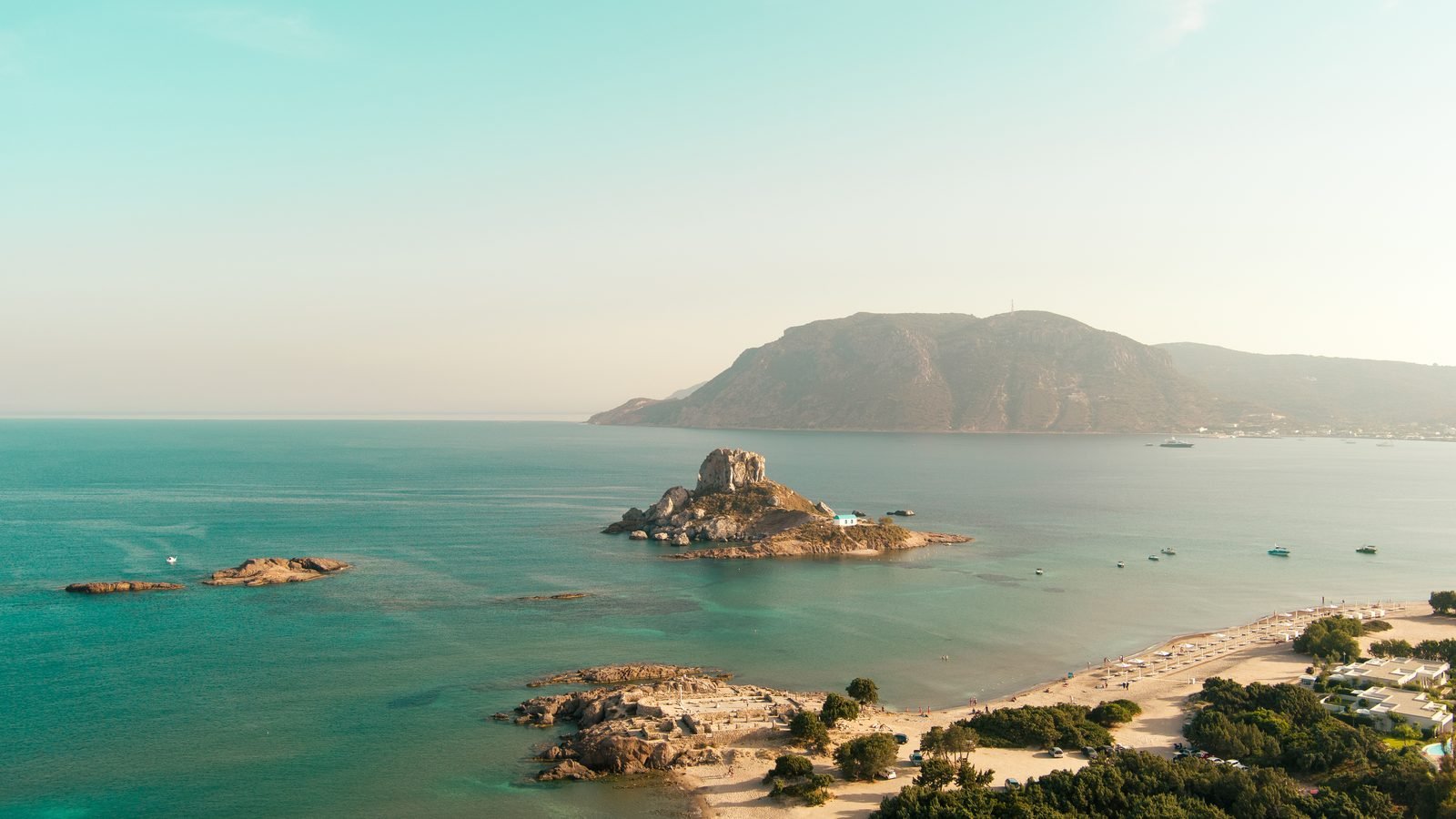
If you have seen one photograph of Kos before booking, it was probably this one. The islet of Kastri lies just offshore with a small chapel on it, and on the beach itself stand the ruins of two fifth-century paleo-Christian basilicas, columns still upright in the sand.
You can pedalo across to the islet, and people do. Come for the whole scene rather than the swim: ruins on one side, a chapel on a rock on the other, the bay in between.
Kefalos and Lagada
A long golden bay with quieter patches in it, and no trick to finding them. Park, then walk along the sand until the people thin out. In August, when Paradise fills by eleven, this is the fallback.
The wild ones: Cavo Paradiso and Agios Theologos
Two beaches for people who want the island without the beach bar, and both come with conditions attached. Cavo Paradiso is at the southern tip, rugged, with minimal amenities. You either walk in from the road or you need a car with decent clearance. The surf is strong there, which is part of why it is beautiful and all of why it is not a beach for small children or hesitant swimmers.
Agios Theologos is on the south Kefalos peninsula, reached by gravel road, and it stays deserted even in high season, which for Kos in August is remarkable. One warning we will not soften: coastal erosion changes that shoreline, so do not lay your towel underneath the rock cliffs. Sit out on the open sand.
The north coast, and the wind nobody warns you about
Tigaki is the north coast family default: Blue Flag, very shallow, fully organised, with a salt lake behind it. Marmari gives you 3 km of white sand and dunes, sunset, horse riding and kitesurfing. Mastichari has sand, dunes, kitesurfers and the Kalymnos ferry, so you can pair a beach morning with a boat.
Here is the part the brochures leave out. The meltemi, the north wind, blows from mid-May onwards. It is weaker on Kos than on the central Aegean islands, so nobody should cancel a holiday over it, but it lands on the north coast. Tigaki, Marmari and Mastichari take it directly. That is precisely why the kitesurfers are there.
Kardamena faces south and is sheltered from it. That is geography, not marketing, and you can check it. The practical version: if the palms along the front are moving hard in the morning, spend the day south or west rather than sitting behind a windbreak up north. How the wind, the heat and the sea temperature change through the year is in our month-by-month guide to visiting Kos.
If your day takes you past Kos Town, keep going east to Therma, where thermal springs run down black volcanic pebbles into a rock pool at the water's edge.
Sunbeds, umbrellas and what they should cost
Expect around €10 for two loungers and an umbrella as of the 2026 season. That figure holds across Kardamena, Tigaki, Paradise and Cavo Paradiso, so if you are quoted well above it, walk twenty metres and ask the next set.
Some beach bars in Kardamena give you the beds free with a food or drink order. Not all of them, and it is rarely advertised, so ask before you sit down. The question is completely normal here.
West of Cape Helona, at Agios Theologos and on most of Camel, plan on no beds at all. A cheap umbrella bought in the village on day one pays for itself by day three.
The 2026 beach rules and the MyCoast app
Greece runs a national list of protected beaches, known as the untrodden beaches, and for 2026 that list grew to 251. On a listed beach, 70% of the sand must stay free of sunbeds, rising to 85% inside a Natura 2000 zone. No vehicles on the sand. No gatherings of more than ten people. No amplified music.
Enforcement has historically been patchy, so do not assume a listed beach looks like the rules describe. The public reports violations through the MyCoast app.
In practice it is simpler than the legal detail. Free sand exists by law, so you can put a towel down without hiring anything. And if you are planning a day around one quiet beach, check whether it is currently listed, because the list changes.
Getting to all of this
Everything west of Kefalos Bay is a car day. Hire one for two or three days rather than the whole week: as of the 2026 season, economy cars run at roughly €18 to €35 a day in low season and €35 to €55 in July and August. Book six to eight weeks ahead, three to four months for August. The full picture is in our honest answer on whether you need a car in Kos.
Parking is the part people forget to price in. We have free private parking in front of the building, so keeping a hire car overnight costs you nothing.
By bus, be realistic. KTEL Kos runs the network on 22420-22292 and ktel-kos.gr, and the fares we can quote with confidence are the airport routes: Kardamena €2.50, Kefalos €3.20, Mastichari €2.50, and Kos Town to Kardamena €4.20 for about 40 minutes. Ring them and ask what runs on the day rather than trusting a printed timetable. Carry cash, card is not accepted on all routes, and Sunday services are severely reduced. By taxi there is no official published Kos tariff sheet, so agree the fare first.
One last thing, plainly. Our own beach is the one you will use most, and that is not a consolation prize. Five minutes on foot, facing the right way, and the reason a week here works even if you never get in a car. For the village weighed up with children in mind, see our piece on whether Kardamena works for families.
Quick answers
Why does the water bubble at Paradise Beach in Kos?
Volcanic carbon dioxide rises through the seabed a few metres offshore, and the spot is marked by a buoy. Kos sits on the Hellenic Volcanic Arc, the same geology that built the Nisyros volcano next door. The gas does not heat the sea, although the seabed is warm to the touch in places, which is where the hot water story comes from.
How do I get to Paradise Beach from Kardamena?
Paradise Beach is in Kefalos Bay, about 20 km west of Kardamena, and the simplest way to reach it is a hire car for the day. There is no direct service we can promise you, so if you want to go by bus, ring KTEL Kos on 22420-22292 or check ktel-kos.gr for what runs on the day. Remember that Sunday services are severely reduced.
How much do sunbeds cost on Kos beaches?
Expect around €10 for two loungers and an umbrella as of the 2026 season, and that holds across Kardamena, Tigaki, Paradise and Cavo Paradiso. Some Kardamena beach bars give you the beds free with a food or drink order, but not all of them do, so ask before you sit down.
Which beaches on Kos are sheltered from the meltemi wind?
The meltemi blows from mid-May and it hits the north coast, which means Tigaki, Marmari and Mastichari. Kardamena faces south and is sheltered from it. The wind is weaker on Kos than on the central Aegean islands, but on a breezy day head south or west rather than north.
Which beach near Kardamena is best with small children?
Kardamena beach itself: fine sand, sheltered water, and a flat palm-lined waterfront that works with a pushchair. Paradise Beach is the other one, shallow and gently sloping, with changing rooms, a restaurant and a water park. Camel Beach needs a short hike down from the parking area and Cavo Paradiso has strong surf, so leave those for a different day.
What are the 2026 untrodden beaches rules in Greece?
The national untrodden beaches list grew to 251 for 2026. Those beaches must stay 70% free of sunbeds, rising to 85% inside Natura 2000 zones, with no vehicles, no gatherings of more than ten people and no amplified music. The public reports violations through the MyCoast app, though enforcement has historically been patchy, so check the current list before you build a day around it.
Last updated: August 2026